
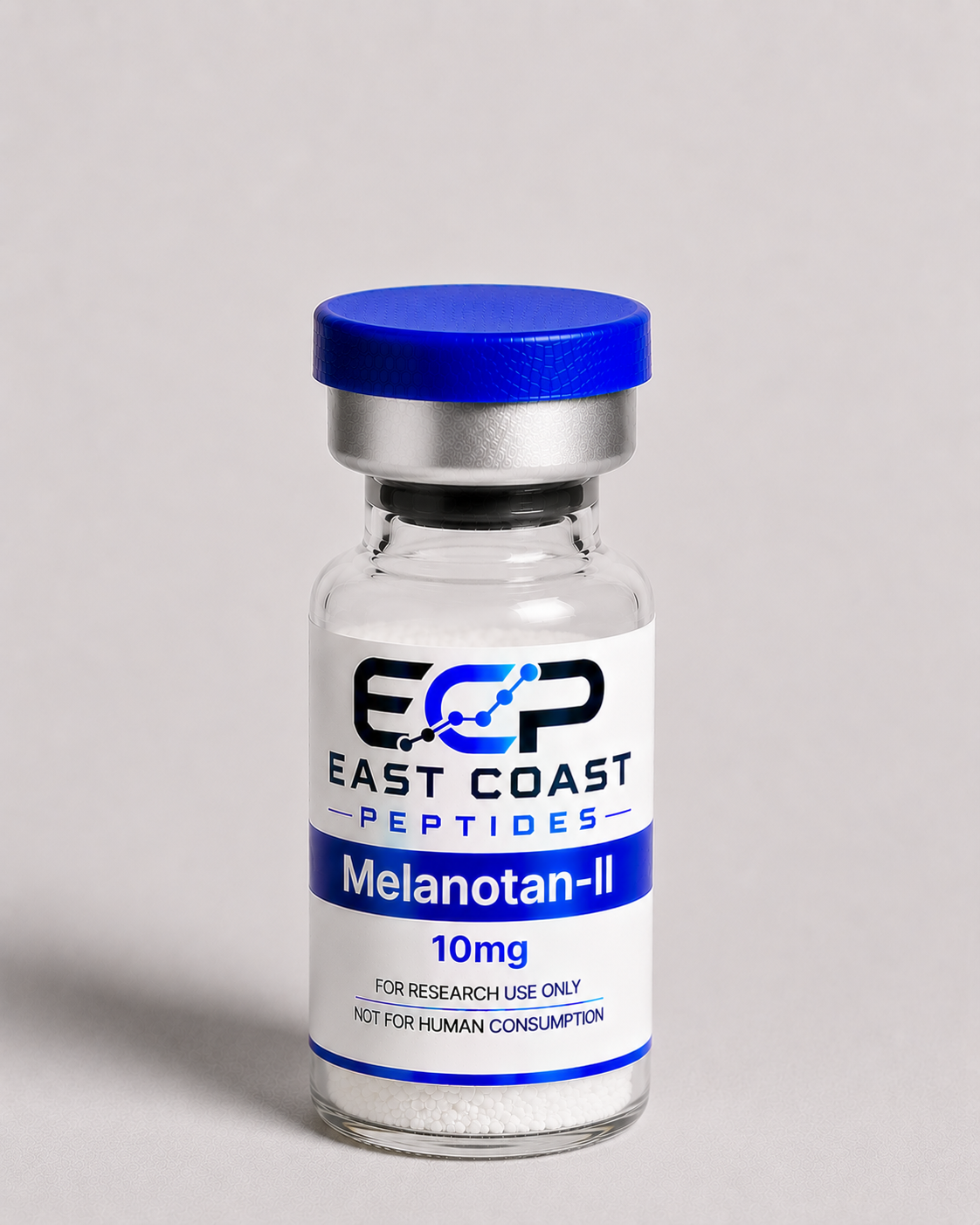
Understanding Melanotan II: A Comprehensive Guide
Explore Melanotan II research, including MC1R-mediated pigmentation, MC3R and MC4R signaling, appetite regulation, energy balance, sexual-function pathways, inflammatory signaling, and broad melanocortin receptor pharmacology.
In this article8 sections
MC1R
MC2R
MC3R
Melanotan II, commonly abbreviated as MT-II, is a synthetic cyclic peptide analog of alpha-melanocyte-stimulating hormone, or α-MSH.
Alpha-MSH is an endogenous melanocortin peptide derived from the larger pro-opiomelanocortin precursor. It interacts with several melanocortin receptors involved in pigmentation, energy balance, inflammatory signaling, and sexual function.
MT-II was developed as a more stable and potent melanocortin agonist than native α-MSH. Its compact cyclic structure and broad receptor activity have made it a frequently used research compound in studies involving melanogenesis, hypothalamic appetite pathways, energy metabolism, reproductive signaling, and melanocortin receptor pharmacology.
For research use only. Not intended for human or veterinary use. This article is provided for scientific and educational purposes and does not constitute medical, cosmetic, therapeutic, formulation, reconstitution, or dosing advice.
What Is the Melanocortin System?
The melanocortin system is a network of peptide hormones and five G-protein-coupled receptors known as:
- MC1R
- MC2R
- MC3R
- MC4R
- MC5R
The endogenous melanocortin peptides are produced through enzymatic processing of pro-opiomelanocortin, commonly abbreviated as POMC.
POMC-derived peptides include:
- Adrenocorticotropic hormone
- Alpha-MSH
- Beta-MSH
- Gamma-MSH
- Beta-endorphin
These peptides influence a wide range of biological systems, including:
- Skin and hair pigmentation
- Adrenal steroid production
- Food intake
- Energy expenditure
- Sexual function
- Exocrine secretion
- Inflammatory signaling
- Immune regulation
The Five Melanocortin Receptors
Each melanocortin receptor has a different tissue distribution and biological role.
MC1R
MC1R is expressed primarily on melanocytes, the cells responsible for melanin production.
Its functions include:
- Eumelanin synthesis
- Pigmentation
- UV-response biology
- Melanocyte survival
- Inflammatory regulation
- Immune-cell signaling
MC1R is the main receptor responsible for the pigmentation effects associated with MT-II.
MC2R
MC2R is expressed mainly in the adrenal cortex.
It is the principal receptor for adrenocorticotropic hormone and regulates adrenal steroid synthesis, including cortisol production.
Unlike the other melanocortin receptors, MC2R is not meaningfully activated by standard α-MSH analogs such as MT-II.
MC3R
MC3R is found in the central nervous system and several peripheral tissues.
Research areas include:
- Energy homeostasis
- Feeding behavior
- Nutrient partitioning
- Sodium balance
- Inflammatory regulation
MC3R activity may contribute to some of MT-II’s metabolic and appetite-related effects.
MC4R
MC4R is expressed extensively in the hypothalamus, brainstem, and spinal cord.
It is strongly associated with:
- Appetite suppression
- Satiety
- Energy expenditure
- Autonomic signaling
- Sexual arousal
- Erectile responses
Many of MT-II’s central effects are attributed to MC4R activation.
MC5R
MC5R is expressed in several exocrine and peripheral tissues.
Its functions may include:
- Sebaceous secretion
- Lacrimal function
- Salivary secretion
- Immune modulation
- Peripheral metabolic regulation
What Is Melanotan II?
Melanotan II is a synthetic cyclic heptapeptide derived from the active region of α-MSH.
Its structure is commonly described as:
Ac-Nle-c[Asp-His-D-Phe-Arg-Trp-Lys]-NH₂
The peptide includes several modifications designed to increase receptor activity and biological stability.
These include:
- Replacement of methionine with norleucine
- Replacement of L-phenylalanine with D-phenylalanine
- Cyclization through a lactam bridge
- Truncation of the native α-MSH sequence
These structural changes produce a compound that is more conformationally constrained and resistant to enzymatic degradation than native α-MSH.
Why Is MT-II Cyclic?
Cyclization restricts the peptide’s movement and helps maintain a receptor-binding conformation.
Compared with a flexible linear peptide, a cyclic peptide may demonstrate:
- Greater metabolic stability
- Improved resistance to proteases
- Increased receptor affinity
- Longer biological activity
- Altered tissue distribution
- Greater central nervous system effects
This cyclic structure is one of the major differences between Melanotan II and the longer, linear Melanotan I peptide.
Melanotan II Receptor Profile
MT-II is considered a broad or nonselective melanocortin agonist.
It activates:
- MC1R
- MC3R
- MC4R
- MC5R
It has comparatively little relevance to MC2R signaling.
This broad receptor profile explains why MT-II can affect several biological systems at the same time.
Its nonselectivity is useful for studying the melanocortin network as a whole, but it can also make receptor-specific conclusions more difficult.
MC1R Signaling and Pigmentation
MT-II stimulates pigmentation primarily through MC1R activation on melanocytes.
MC1R is coupled to a stimulatory G protein.
When activated, it initiates a signaling pathway involving:
- Adenylyl cyclase
- Cyclic AMP
- Protein kinase A
- CREB phosphorylation
- Increased MITF activity
- Upregulation of melanogenic enzymes
MITF, or microphthalmia-associated transcription factor, is a central regulator of melanocyte development and melanin production.
Melanogenesis
Melanogenesis is the biological process through which melanocytes produce pigment.
Important enzymes in this process include:
- Tyrosinase
- Tyrosinase-related protein 1
- Tyrosinase-related protein 2
MC1R activation increases expression and activity of these enzymes, promoting greater production of eumelanin.
Eumelanin and Pheomelanin
Human pigmentation includes two major forms of melanin.
Eumelanin
Eumelanin is a brown-to-black pigment associated with:
- Darker skin and hair
- Greater UV absorption
- Antioxidant activity
- Increased photoprotective capacity
Pheomelanin
Pheomelanin is a yellow-to-red pigment associated with:
- Lighter pigmentation
- Reduced UV absorption
- Greater oxidative activity under some conditions
MC1R signaling helps shift melanocytes toward eumelanin production.
This makes MT-II relevant to research involving pigment type, density, and UV-response biology.
Pigmentation Research
MT-II has been studied for its ability to increase skin pigmentation through MC1R activation.
Research questions may include:
- How melanocortin signaling affects melanin production
- Whether pigmentation can increase without direct UV exposure
- How pigment density influences UV responses
- How MC1R genotype changes peptide responsiveness
- How melanocytes interact with surrounding keratinocytes
- Whether melanogenesis influences oxidative stress
MT-II is useful for pigmentation research, although its simultaneous activation of central melanocortin receptors can introduce additional variables.
Photoprotection Research
Melanin absorbs ultraviolet radiation and can reduce the amount of UV energy reaching cellular DNA.
Potential protective effects include:
- Lower oxidative stress
- Reduced formation of DNA lesions
- Decreased keratinocyte injury
- Fewer sunburn cells
- Greater tolerance to controlled UV exposure
However, increased pigmentation does not eliminate the biological risks associated with ultraviolet radiation.
Visible darkening should not be interpreted as complete protection against sunburn, DNA damage, photoaging, or skin cancer.
MC4R and Appetite Regulation
MC4R is a major component of the hypothalamic pathways that regulate food intake and energy balance.
It operates downstream of several metabolic signals, including:
- Leptin
- Insulin
- POMC neurons
- Agouti-related peptide neurons
- Neuropeptide Y neurons
Activation of MC4R generally promotes satiety and reduces food intake.
MT-II has therefore become a common pharmacological tool in appetite and obesity research.
The Leptin-Melanocortin Pathway
The leptin-melanocortin pathway helps the brain assess long-term energy availability.
Leptin is released primarily by adipose tissue.
When energy stores are adequate, leptin activates hypothalamic POMC neurons.
POMC-derived melanocortins then activate MC4R and influence:
- Reduced food-seeking behavior
- Increased satiety
- Greater energy expenditure
- Autonomic output
- Glucose metabolism
MT-II can stimulate parts of this pathway by directly activating melanocortin receptors.
MC4R and Human Obesity Research
Loss-of-function mutations in MC4R are a recognized genetic cause of severe early-onset obesity.
This genetic evidence demonstrates that MC4R plays a central role in human energy regulation.
MT-II has been used in preclinical studies to examine:
- MC4R-dependent satiety
- Receptor responsiveness
- Food-intake suppression
- Energy expenditure
- Hypothalamic circuit activity
- Genetic obesity models
Animals lacking functional MC4R generally show reduced or absent anorectic responses to melanocortin agonists, supporting the receptor’s central role.
MC3R and Energy Homeostasis
MC3R may also contribute to metabolic regulation.
Its precise role is more complex than that of MC4R and may involve:
- Nutrient partitioning
- Feeding rhythms
- Energy efficiency
- Peripheral metabolism
- Inflammatory signaling
Because MT-II activates both MC3R and MC4R, appetite or metabolic findings cannot always be assigned to one receptor without specific experimental controls.
Energy Expenditure
Melanocortin receptor activation may influence energy expenditure through:
- Sympathetic nervous system activity
- Thermogenic signaling
- Brown adipose tissue
- Locomotor activity
- Thyroid-axis interactions
- Peripheral substrate metabolism
The magnitude and direction of these effects can vary by species, nutritional status, ambient temperature, and experimental design.
Sexual-Function Research
MT-II is also widely studied for its effects on sexual arousal and genital responses.
These effects are primarily associated with central MC4R pathways.
Relevant regions include:
- The paraventricular nucleus
- Hypothalamic reproductive circuits
- Brainstem autonomic centers
- Spinal genital reflex pathways
MT-II research helped establish that central melanocortin signaling can influence sexual function independently of direct peripheral vasodilation.
Central Sexual Signaling
MC4R activation may affect:
- Sexual motivation
- Arousal
- Erectile signaling
- Genital responses
- Autonomic activity
- Oxytocin-related pathways
- Spinal reflex circuits
This mechanism differs from phosphodiesterase type 5 inhibitors, which act mainly through nitric oxide and cyclic GMP signaling in peripheral vascular tissue.
Male Sexual-Function Research
In male experimental models, MT-II has been studied in relation to:
- Erectile responses
- Spontaneous erectile activity
- Hypothalamic signaling
- Spinal reflex activation
- Sexual motivation
- Response in models of erectile dysfunction
Clinical research also investigated erectile responses in men, helping establish proof of concept for the development of related melanocortin compounds.
Female Sexual-Function Research
In female models, melanocortin signaling has been studied in relation to:
- Sexual motivation
- Genital blood flow
- Arousal
- Receptive behavior
- Hypothalamic activation
- Hormonal-state interactions
Responses can vary according to estrogen status, reproductive phase, and experimental conditions.
MT-II and Oxytocin Signaling
Some research suggests that MC4R activation may interact with hypothalamic oxytocin pathways.
Oxytocin neurons project to brainstem and spinal regions involved in autonomic and reproductive responses.
Potential mechanisms include:
- Increased oxytocin-neuron activity
- Enhanced spinal signaling
- Coordination of central and peripheral sexual responses
- Interaction with dopamine pathways
The exact contribution of oxytocin can vary by species and experimental model.
Development of PT-141
The observation that MT-II influenced sexual responses led to development of PT-141, also known as bremelanotide.
PT-141 is structurally related to MT-II but has a different functional receptor profile.
It retains strong central melanocortin activity while producing less prominent pigmentation.
This makes PT-141 a more targeted research compound for sexual-function and central MC4R studies.
Melanotan II vs. PT-141
| Property | Melanotan II | PT-141 |
|---|---|---|
| Structure | Cyclic heptapeptide | Related cyclic heptapeptide |
| MC1R activity | Significant | Reduced |
| MC3R activity | Significant | Significant |
| MC4R activity | Significant | Significant |
| Pigmentation | Prominent | Less prominent |
| Sexual-function research | Strong | Primary focus |
| Appetite research | Relevant | Relevant |
| Research profile | Broad melanocortin agonist | More CNS-focused |
| Regulatory development | No approved MT-II drug | Pharmaceutical bremelanotide developed |
PT-141 may be preferable when pigmentation would interfere with a central sexual-function or appetite study.
MT-II remains useful when simultaneous activation of pigmentation and central melanocortin pathways is relevant.
Melanotan II vs. Melanotan I
Melanotan I and Melanotan II are related but meaningfully different.
| Property | Melanotan I | Melanotan II |
|---|---|---|
| Structure | Linear 13-amino-acid peptide | Cyclic 7-amino-acid peptide |
| Main research focus | Pigmentation and photoprotection | Broad melanocortin signaling |
| MC1R activity | Prominent | Prominent |
| MC3R/MC4R activity | Less functionally prominent | Stronger |
| CNS effects | More limited | More prominent |
| Appetite effects | Less prominent | More prominent |
| Sexual effects | Less prominent | More prominent |
| Pigmentation | Strong | Strong |
MT-I is generally used when pigmentation and photoprotection are the primary research objectives.
MT-II is better suited to research involving several melanocortin pathways simultaneously.
Anti-Inflammatory Research
Melanocortin signaling has also been studied for anti-inflammatory and immunomodulatory effects.
Potential mechanisms include:
- Reduced NF-kappa B activation
- Lower pro-inflammatory cytokine production
- Altered macrophage behavior
- Reduced leukocyte migration
- Changes in oxidative stress
- Modulation of immune-cell signaling
Cytokines commonly studied include:
- TNF-alpha
- IL-1 beta
- IL-6
These effects may involve MC1R, MC3R, MC5R, or combinations of receptors depending on the tissue.
Neuroinflammation Research
MT-II has been investigated in models of central nervous system inflammation.
Research areas may include:
- Microglial activation
- Cytokine production
- Ischemic injury
- Neuroimmune signaling
- Oxidative stress
- Traumatic injury
- Autoimmune inflammation
Findings are highly model-dependent, and broad receptor activity can make the precise mechanism difficult to identify.
Neuroprotective Research
Melanocortin receptor activation has been studied in experimental models of neuronal injury.
Proposed mechanisms include:
- Reduced inflammatory signaling
- Lower oxidative damage
- Improved cellular survival
- Modulation of mitochondrial function
- Changes in apoptotic pathways
- Improved vascular responses
These preclinical findings should not be interpreted as established therapeutic benefit.
Exocrine and Peripheral Research
Because MT-II also activates MC5R, it may affect exocrine and peripheral tissues.
Research areas include:
- Sebaceous-gland activity
- Salivary secretion
- Lacrimal function
- Immune regulation
- Peripheral lipid metabolism
These effects may be relevant when broad melanocortin activation is being studied.
MC1R Genetic Variation
The MC1R gene contains many naturally occurring variants.
Some variants are associated with:
- Fair skin
- Red hair
- Freckling
- Lower eumelanin production
- Reduced tanning response
- Increased UV sensitivity
MC1R genotype can influence the pigmentation response to melanocortin agonists.
Researchers should therefore consider receptor genotype when comparing subjects, tissues, or cell models.
Receptor Selectivity and Experimental Interpretation
MT-II is not a receptor-selective compound.
An observed result could involve:
- MC1R
- MC3R
- MC4R
- MC5R
- Multiple receptors at once
Appropriate experimental controls may include:
- Receptor-selective antagonists
- Knockout models
- Gene-silencing techniques
- Receptor-expression analysis
- Selective comparison agonists
- Vehicle controls
- Pathway-specific biomarkers
Without these controls, it may be difficult to assign an effect to a single melanocortin receptor.
Central Nervous System Penetration
MT-II’s compact cyclic structure is associated with stronger central effects than longer linear melanocortin analogs.
However, CNS exposure can vary according to:
- Route of exposure
- Species
- Dose
- Blood-brain barrier condition
- Peptide stability
- Circulating protein binding
- Experimental timing
Structural properties alone do not fully establish brain distribution.
Receptor Desensitization
Repeated or sustained exposure to a G-protein-coupled receptor agonist can reduce receptor responsiveness.
Possible mechanisms include:
- Receptor phosphorylation
- Beta-arrestin recruitment
- Internalization
- Reduced surface expression
- Downstream signaling adaptation
Exposure duration and pattern should therefore be considered in long-term MT-II experiments.
Common Research Applications
Melanotan II may be used in studies involving:
- MC1R signaling
- Melanogenesis
- Eumelanin production
- Pigmentation
- UV-response biology
- MC3R pharmacology
- MC4R pharmacology
- Appetite regulation
- Energy expenditure
- Obesity models
- Sexual arousal
- Erectile signaling
- Neuroinflammation
- Immune modulation
- Exocrine function
Its broad receptor activity is both its main advantage and its primary limitation.
Experimental Design Considerations
Important variables include:
- Species
- Sex
- Age
- Hormonal status
- Feeding state
- MC1R genotype
- MC3R and MC4R expression
- Baseline pigmentation
- Exposure pattern
- Tissue distribution
- Measurement timing
- Environmental temperature
- Stress
- Light exposure
The same compound may produce very different outcomes across experimental systems.
Measuring Pigmentation Responses
Pigmentation research may use:
- Melanin index
- Reflectance spectroscopy
- Digital photography
- Colorimetry
- Histological staining
- Melanin-content assays
- Tyrosinase activity
- MITF expression
- Gene-expression analysis
Objective measurements are generally more reliable than visual inspection alone.
Measuring Appetite and Metabolic Effects
Metabolic studies may measure:
- Food intake
- Meal size
- Meal frequency
- Body weight
- Energy expenditure
- Oxygen consumption
- Respiratory exchange ratio
- Locomotor activity
- Glucose handling
- Thermogenesis
- Hypothalamic neuronal activation
Pair-fed controls may be needed to distinguish direct metabolic effects from changes caused solely by reduced food intake.
Measuring Sexual-Function Responses
Sexual-function research may assess:
- Genital responses
- Erectile activity
- Receptive behavior
- Motivation
- Autonomic output
- Hypothalamic activation
- Spinal reflexes
- Hormonal changes
Interpretation should separate central motivation from peripheral vascular or mechanical effects.
Product Quality Considerations
Research-grade MT-II should be supported by lot-specific analytical documentation.
Useful information may include:
- Amino-acid sequence
- Molecular formula
- Molecular weight
- HPLC purity
- Mass-spectrometry identity
- Net peptide content
- Counterion form
- Lot number
- Endotoxin testing
- Sterility testing where relevant
- Stability data
- Storage requirements
A high purity percentage does not independently confirm receptor potency or biological activity.
Laboratory Handling
Melanotan II is commonly supplied as a lyophilized research peptide.
Laboratories should follow the supplier’s validated documentation concerning:
- Solvent compatibility
- Reconstitution
- Storage temperature
- Light protection
- Working-solution stability
- Freeze-thaw limitations
- Container compatibility
- Microbial control
- Disposal procedures
Generalized preparation instructions should not replace product-specific documentation or an approved institutional laboratory protocol.
Stability Considerations
MT-II stability may be affected by:
- Temperature
- Light
- Oxygen
- Moisture
- pH
- Repeated freeze-thaw cycles
- Surface adsorption
- Microbial contamination
- Enzymatic degradation
Lyophilized and prepared forms may have substantially different stability profiles.
Research Limitations
Important limitations include:
- MT-II activates several melanocortin receptors
- Receptor-specific effects can be difficult to isolate
- Pigmentation may confound central research
- Appetite effects can indirectly alter metabolism
- Sexual-function findings may vary by hormonal state
- Species differences can affect receptor pharmacology
- CNS penetration is model-dependent
- Long-term exposure may cause desensitization
- Product purity does not guarantee potency
- Preclinical results do not automatically translate to humans
Conclusion
Melanotan II is a cyclic α-MSH analog with broad agonist activity at MC1R, MC3R, MC4R, and MC5R.
Its principal research mechanisms include:
- MC1R-mediated melanogenesis
- MC3R- and MC4R-related energy regulation
- MC4R-mediated sexual-function signaling
- Melanocortin-related inflammatory modulation
- Peripheral and exocrine receptor activity
MT-II is widely used because its compact cyclic structure provides greater stability and broader central activity than native α-MSH or longer linear analogs.
This broad pharmacology makes it valuable for studying interactions among pigmentation, appetite, metabolism, sexual function, and inflammatory signaling.
It also requires careful experimental controls because observed effects may involve several receptors simultaneously.
For research use only. Not intended for human or veterinary use. This article is provided for scientific and educational purposes and does not constitute medical, cosmetic, therapeutic, performance-enhancement, formulation, reconstitution, or dosing advice.
Explore compounds with clarity.
Review the ECP catalog alongside clear product information and available quality documentation.
Leave a Reply