
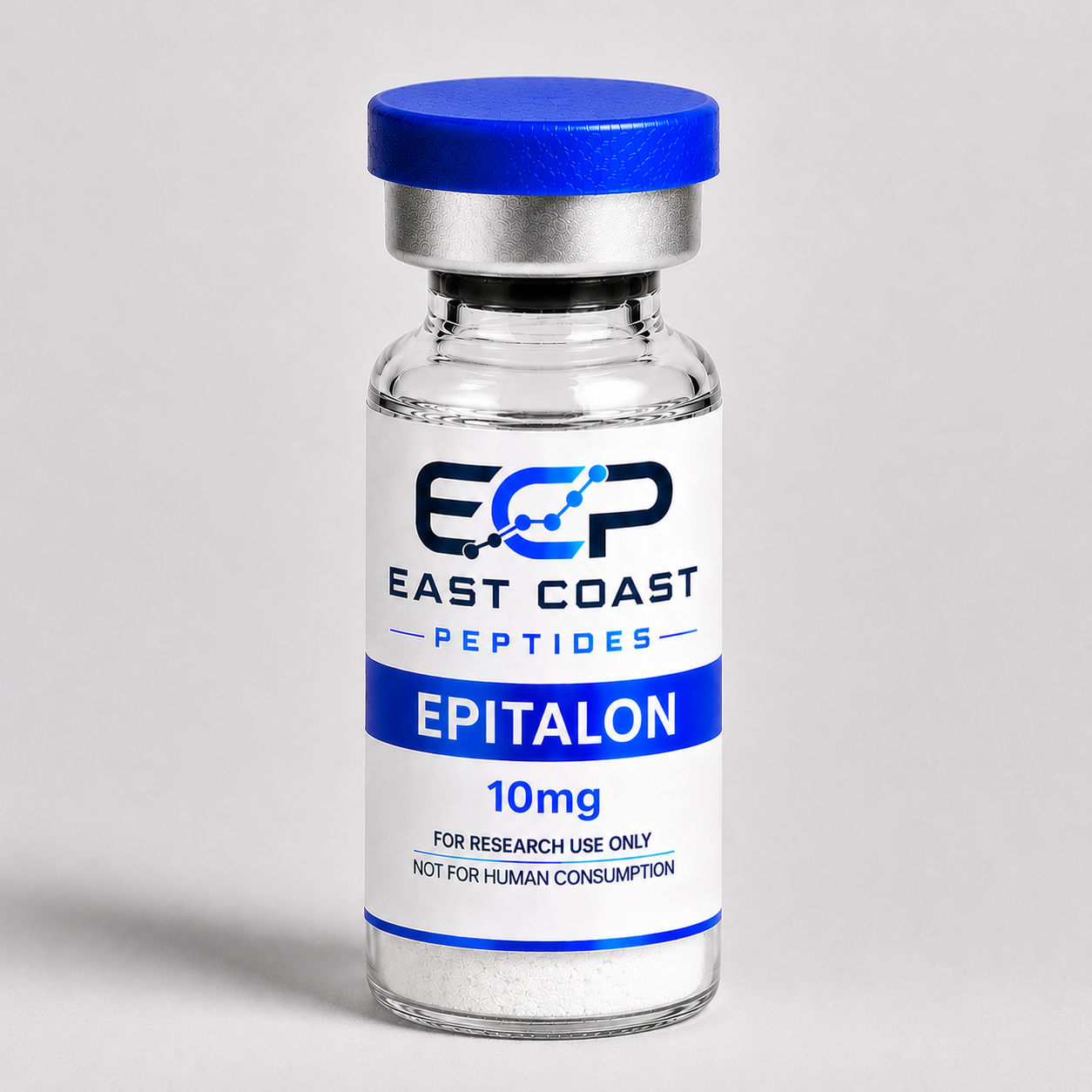
Epithalon: The Science Behind This Synthetic Peptide
Discover the science of Epithalon and its impact on telomeres, melatonin, and cellular aging research.
In this article8 sections
Telomerase activity
Telomere maintenance
Replicative senescence
Epithalon, also spelled Epitalon, is a synthetic tetrapeptide composed of four amino acids:
Ala-Glu-Asp-Gly
It was developed from epithalamin, a peptide extract associated with the pineal gland, through the research program of Vladimir Khavinson and colleagues at the St. Petersburg Institute of Bioregulation and Gerontology.
Epithalon has been studied primarily in aging-related research, including investigations of telomerase activity, telomere length, melatonin production, circadian regulation, oxidative stress, and age-associated disease models.
Its emphasis on telomere biology and short-peptide gene regulation gives Epithalon a research profile that differs substantially from many other experimental peptides.
For research use only. Not intended for human or veterinary use.
What Is Epithalon?
Epithalon is a synthetic short peptide based on research involving epithalamin, a complex peptide preparation originally derived from pineal tissue.
The compound belongs to a broader category known as short peptide bioregulators. These are small peptides, often containing two to four amino acids, that have been studied for possible effects on tissue-specific gene expression and age-related cellular function.
Epithalon is particularly associated with research involving:
- Telomerase activity
- Telomere maintenance
- Replicative senescence
- Pineal-gland function
- Melatonin production
- Circadian rhythm
- Oxidative stress
- Longevity models
Background: Short Peptide Bioregulators
The short peptide bioregulator concept was developed through research programs examining peptides derived from tissues such as the pineal gland, thymus, liver, brain, and retina.
The central hypothesis is that certain short peptides may help regulate gene expression in a tissue-specific manner. According to this model, age-related declines in cellular signaling and protein synthesis may be influenced by small peptide sequences capable of interacting with gene-regulatory systems.
Epithalon was developed as a synthetic analog of a pineal-associated bioregulator, with the goal of producing a simpler and more chemically defined compound than a complex tissue extract.
A substantial portion of the research originated from Russian institutions. Some studies have appeared in indexed scientific journals, but the evidence base still requires careful evaluation because independent replication remains limited.
Structure and Chemical Properties
Epithalon consists of four amino acids:
- Alanine
- Glutamic acid
- Aspartic acid
- Glycine
Key characteristics
Sequence: Ala-Glu-Asp-Gly
Peptide length: Four amino acids
Approximate molecular weight: 390.35 Da
Net charge: Generally negative at physiological pH because of the glutamic acid and aspartic acid residues
Primary research focus: Telomerase activity and telomere biology
Additional research areas: Melatonin regulation, antioxidant activity, cellular aging, and gene expression
Its very small size distinguishes Epithalon from longer signaling peptides and contributes to the hypothesis that it may interact with intracellular regulatory systems rather than acting exclusively through a conventional cell-surface receptor.
Telomeres and Cellular Aging
Telomeres are repetitive DNA sequences located at the ends of chromosomes.
They protect chromosome ends during cell division, but they generally become shorter as cells continue to divide. When telomeres become critically short, cells may enter senescence or undergo programmed cell death.
Telomere attrition is therefore widely studied as one component of biological aging.
Telomerase is an enzyme complex that can extend telomeres by adding repeated DNA sequences to chromosome ends. In most mature somatic cells, telomerase activity is low or absent.
Because of this, compounds that appear to influence telomerase activity are of significant interest in aging and cellular-longevity research.
Epithalon and Telomerase Activity
Epithalon is best known for research suggesting that it may influence telomerase expression and telomere length.
In cell-culture studies, researchers reported that Epithalon exposure was associated with increased telomerase activity and extended replicative capacity in certain human fibroblast models.
These findings led to the proposal that Epithalon may influence expression of hTERT, the catalytic component of human telomerase.
The proposed sequence is:
Epithalon exposure → altered gene regulation → increased telomerase activity → improved telomere maintenance
However, this mechanism has not been fully characterized at the molecular level, and large-scale independent replication remains limited.
Replicative Senescence
Replicative senescence occurs when cells permanently stop dividing after reaching a biological limit.
This limit is influenced in part by progressive telomere shortening.
Some Epithalon studies have reported that treated cells completed additional divisions beyond the expected replicative limit. These findings have made the peptide relevant to research involving:
- Cellular lifespan
- Fibroblast aging
- Telomere shortening
- Senescence markers
- DNA stability
- Age-related loss of tissue function
These observations remain experimental and should not be interpreted as proof that Epithalon reverses aging in living organisms.
Chromatin and Gene-Regulation Research
A distinctive hypothesis within the peptide bioregulator field is that short peptides may interact with chromatin.
Chromatin is the combination of DNA and proteins that controls how genetic information is packaged and accessed.
Research from the Khavinson program has proposed that Epithalon and related peptides may influence:
- Histone-DNA interactions
- Chromatin accessibility
- Gene-promoter activity
- Cellular differentiation
- Antioxidant gene expression
- Tissue-specific protein synthesis
This proposed mechanism differs from the classic model in which a peptide binds a specific cell-surface receptor and activates a signaling cascade.
The chromatin-interaction hypothesis remains an active and debated area of research. More detailed molecular studies are needed to determine whether these effects occur directly or through broader cellular signaling pathways.
Pineal-Gland and Melatonin Research
Epithalon was developed from research involving pineal-gland peptides.
The pineal gland is closely associated with production of melatonin, a hormone involved in:
- Sleep timing
- Circadian rhythm
- Seasonal signaling
- Antioxidant defense
- Immune regulation
- Neuroendocrine function
Melatonin production often declines with age, and circadian rhythms may become less stable in older organisms.
Animal studies have examined whether Epithalon can influence melatonin synthesis or restore age-related changes in pineal function.
Reported findings have included increased nighttime melatonin production and changes in circadian hormone patterns in aged models.
Circadian Rhythm and Sleep-Related Research
Epithalon is sometimes grouped with sleep-related peptides, but its research profile differs from compounds that directly affect sleep architecture.
Its proposed influence on sleep is mainly connected to:
- Pineal function
- Melatonin signaling
- Circadian timing
- Age-related rhythm disruption
- Neuroendocrine aging
This makes Epithalon more relevant to circadian-regulation research than to direct sedative or hypnotic models.
Antioxidant Activity
Oxidative stress results from an imbalance between reactive oxygen species and the body’s antioxidant defenses.
It contributes to cellular damage involving:
- Lipids
- Proteins
- Mitochondria
- DNA
- Cell membranes
Epithalon has been studied in models measuring oxidative-stress markers and antioxidant enzymes.
Reported areas of interest include:
- Reduced lipid peroxidation
- Lower reactive oxygen species
- Increased superoxide dismutase activity
- Increased catalase activity
- Improved resistance to oxidative injury
These antioxidant effects may contribute to the peptide’s broader research profile in aging and tissue preservation.
Lifespan Studies in Animal Models
Several animal studies have examined whether Epithalon affects lifespan or the timing of age-related decline.
Research models have included rodents and invertebrates.
Reported findings in some studies have included:
- Increased median lifespan
- Changes in maximum lifespan
- Delayed age-related reproductive changes
- Reduced incidence of certain pathologies
- Improved markers of physiological aging
These findings are notable but should be interpreted cautiously.
Animal lifespan studies can be influenced by strain, environment, diet, treatment schedule, statistical methods, and study quality. Results from these models cannot be assumed to predict effects in humans.
Tumor and Cancer-Biology Research
Epithalon has also been studied in experimental tumor models.
Some rodent studies reported lower tumor incidence in treated groups. Proposed explanations included:
- Reduced oxidative damage
- Improved genomic stability
- Changes in melatonin signaling
- Immune-system modulation
- Altered gene expression
At the same time, telomerase biology creates an important scientific concern.
Many cancer cells use telomerase to maintain continued replication. A compound that increases telomerase activity in healthy cells could theoretically have different effects depending on tissue type, cellular context, and existing mutations.
For this reason, telomerase activation is considered a complex and potentially double-edged research area.
The available evidence does not establish Epithalon as a cancer treatment or cancer-prevention compound.
Retinal Research
Epithalon has been investigated in experimental models of retinal aging and degeneration.
Researchers have examined whether it may influence:
- Photoreceptor survival
- Retinal structure
- Oxidative damage
- Melatonin-related signaling
- Age-related visual decline
Some animal studies reported preservation of retinal tissue and function compared with untreated controls.
These findings remain preclinical and require further independent verification.
Neurological Aging Research
Separate studies have explored Epithalon in models involving aging brain tissue.
Reported areas of investigation include:
- Neuronal survival
- Antioxidant-enzyme expression
- Neuroendocrine regulation
- Circadian signaling
- Age-related cellular stress
Because melatonin and oxidative stress both influence nervous-system aging, Epithalon’s pineal and antioxidant research profiles may overlap in neurological models.
Human Observational Research
Some research programs have reported long-term observations in older human populations receiving peptide-bioregulator regimens.
Reported outcomes included changes in:
- Mortality
- Cardiovascular markers
- Immune function
- Functional status
- Age-related disease burden
However, many of these studies were not large randomized, blinded, placebo-controlled trials.
Potential limitations include:
- Nonrandomized treatment assignment
- Use of multiple peptide compounds
- Limited blinding
- Institutional population bias
- Incomplete reporting of confounding variables
- Difficulty separating Epithalon-specific effects
These findings are best viewed as observational signals rather than definitive evidence of clinical benefit.
Epithalon Research Limitations
The current evidence base has several important limitations:
- A large proportion of studies came from one research network
- Independent replication is limited
- Some human studies were observational rather than randomized
- Molecular mechanisms remain incompletely defined
- Long-term safety data are insufficient
- Telomerase activation may have context-dependent risks
- Formulations and study protocols vary
- Results from cell and animal studies cannot be directly applied to humans
These limitations do not eliminate the peptide’s research value, but they should shape how findings are interpreted.
Laboratory Formulation and Handling
Epithalon is commonly supplied as a lyophilized research material.
Before preparation, researchers should verify:
- Compound identity
- Peptide purity
- Amino-acid sequence
- Counterion or salt form
- Recommended solvent
- Solubility
- Target research concentration
- Storage temperature
- Light sensitivity
- Freeze-thaw stability
- Batch-specific analytical documentation
General peptide-handling recommendations should not replace manufacturer instructions or a validated laboratory protocol.
The appropriate solvent, concentration, and storage period may vary according to formulation and experimental design.
All prepared solutions should be clearly labeled with the compound name, concentration, solvent, preparation date, storage conditions, and planned discard or retest date.
Conclusion
Epithalon is a synthetic tetrapeptide studied primarily in telomere biology, cellular aging, pineal function, melatonin regulation, circadian rhythm, and oxidative-stress research.
Its most prominent proposed mechanism is the activation of telomerase and the preservation or elongation of telomeres in certain cellular models.
Additional studies have examined its effects in animal longevity, retinal aging, neurological function, antioxidant defense, and tumor biology.
However, much of the evidence originated from a limited number of research groups, and important questions remain regarding independent replication, molecular mechanism, long-term safety, and the context-dependent consequences of telomerase activation.
Epithalon therefore remains a scientifically interesting but incompletely characterized research compound.
For research use only. Not intended for human or veterinary use. This article is provided for educational and scientific purposes and does not constitute medical, treatment, longevity, or dosing advice.
Explore compounds with clarity.
Review the ECP catalog alongside clear product information and available quality documentation.
Leave a Reply