
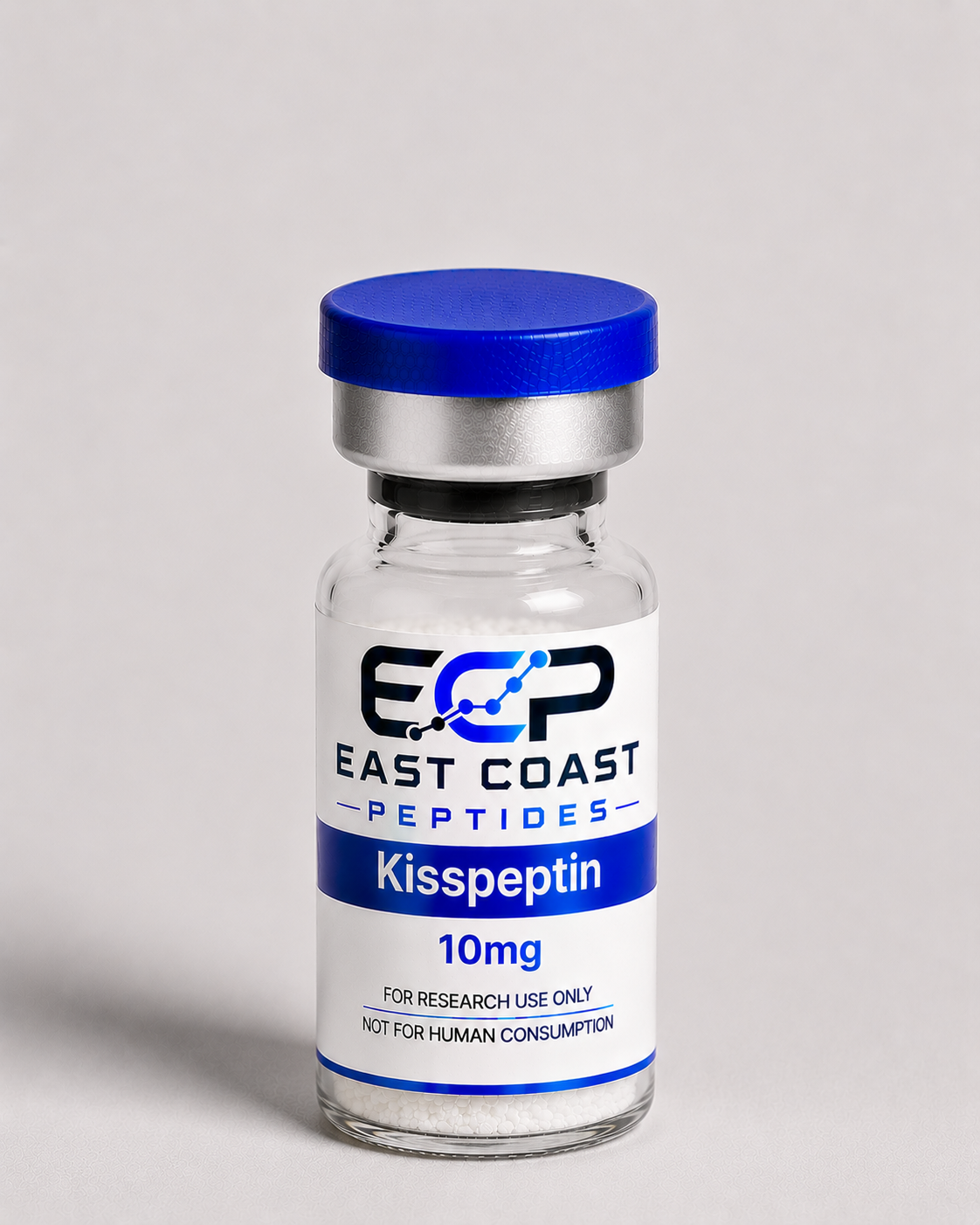
Kisspeptin-10: Key Insights for Reproductive Research
Explore kisspeptin-10 research, including GPR54/KISS1R signaling, GnRH pulsatility, KNDy neurons, puberty, fertility, sex-steroid feedback, and the metabolic regulation of the hypothalamic-pituitary-gonadal axis.
In this article8 sections
Kisspeptin-54
Kisspeptin-14
Kisspeptin-13
Kisspeptin is a family of endogenous neuropeptides encoded by the KISS1 gene. Although KISS1 was first identified in cancer research as a metastasis-suppressor gene, kisspeptin is now best known for its essential role in regulating the hypothalamic-pituitary-gonadal axis.
Kisspeptin peptides activate the KISS1 receptor, also called GPR54, on gonadotropin-releasing hormone neurons. This signaling helps control puberty, reproductive-hormone secretion, fertility, and the pulsatile release of GnRH.
Kisspeptin-10, commonly abbreviated as KP-10, is the shortest naturally derived fragment that retains strong GPR54 agonist activity. Its compact structure and synthetic accessibility have made it one of the most widely studied kisspeptin variants in laboratory research.
For research use only. Not intended for human or veterinary use. This article is provided for scientific and educational purposes and does not constitute medical, fertility, therapeutic, formulation, or dosing advice.
What Is Kisspeptin?
Kisspeptin refers to a group of related peptide fragments produced from a larger precursor encoded by the KISS1 gene.
These peptides share a common C-terminal sequence that allows them to bind and activate GPR54.
The major naturally occurring forms include:
- Kisspeptin-54
- Kisspeptin-14
- Kisspeptin-13
- Kisspeptin-10
All four variants contain the same biologically active C-terminal region.
Kisspeptin-54 is considered a major circulating form, while kisspeptin-10 represents the minimum sequence required for strong receptor activation.
What Is Kisspeptin-10?
Kisspeptin-10 is a 10-amino-acid peptide derived from the C-terminal region of the full kisspeptin precursor.
Its sequence is:
Tyr-Asn-Trp-Asn-Ser-Phe-Gly-Leu-Arg-Phe-NH₂
The C-terminal amidation is important for biological activity and receptor binding.
Key characteristics of KP-10 include:
- Ten amino acids
- Molecular weight of approximately 1,302.5 daltons
- High affinity for KISS1R/GPR54
- Gq/11-coupled receptor signaling
- Relatively short biological duration
- Strong activity at GnRH neurons
Its smaller size makes KP-10 easier to synthesize and characterize than longer kisspeptin variants.
The Hypothalamic-Pituitary-Gonadal Axis
The hypothalamic-pituitary-gonadal axis, commonly abbreviated as the HPG axis, controls reproductive development and hormone production.
The basic signaling sequence is:
Hypothalamus → GnRH → pituitary gland → LH and FSH → gonads
The hypothalamus releases gonadotropin-releasing hormone.
GnRH then stimulates the anterior pituitary to release:
- Luteinizing hormone
- Follicle-stimulating hormone
LH and FSH act on the gonads and regulate:
- Sex-steroid production
- Spermatogenesis
- Follicular development
- Ovulation
- Gamete maturation
- Reproductive function
Kisspeptin acts upstream of GnRH and helps determine when GnRH neurons become active.
Why GnRH Pulsatility Matters
GnRH is normally released in pulses rather than continuously.
The frequency and amplitude of those pulses influence pituitary secretion of LH and FSH.
Pulsatile GnRH supports normal reproductive signaling, while continuous exposure can suppress pituitary responsiveness through receptor desensitization.
This distinction is fundamental to reproductive endocrinology.
Kisspeptin research is especially important because kisspeptin neurons help regulate the timing and intensity of GnRH pulses.
Discovery of the Kisspeptin-GPR54 Reproductive Pathway
The role of kisspeptin in reproduction became clear after researchers identified loss-of-function mutations in GPR54.
Individuals with disruptive GPR54 mutations were found to have:
- Absent or severely delayed puberty
- Low LH and FSH
- Reduced sex-steroid production
- Hypogonadotropic hypogonadism
- Infertility
Other pituitary functions could remain relatively intact.
These findings demonstrated that kisspeptin-GPR54 signaling is required for normal activation of the reproductive axis.
Mutations affecting KISS1 itself have also been linked to impaired pubertal and reproductive development.
GPR54, or KISS1R
The kisspeptin receptor is known by two common names:
- GPR54
- KISS1R
It is a G-protein-coupled receptor expressed on GnRH neurons and in several peripheral tissues.
When kisspeptin binds to GPR54, the receptor primarily activates Gq/11 signaling.
This initiates a signaling cascade involving:
- Phospholipase C
- Inositol trisphosphate
- Diacylglycerol
- Intracellular calcium release
- Protein kinase C
The result is depolarization and activation of GnRH neurons.
How Kisspeptin Activates GnRH Neurons
Kisspeptin neurons form functional connections with GnRH neurons.
After GPR54 activation:
- Phospholipase C becomes activated
- IP3 and DAG are produced
- Intracellular calcium concentrations rise
- Protein kinase C signaling increases
- GnRH neurons depolarize
- GnRH is released into the hypophyseal portal circulation
GnRH then travels to the anterior pituitary and stimulates gonadotroph cells to release LH and FSH.
This places kisspeptin near the top of the reproductive neuroendocrine hierarchy.
Kisspeptin Neuron Distribution
Kisspeptin neurons are concentrated primarily in two hypothalamic regions:
- The arcuate nucleus
- The anteroventral periventricular region
These populations have partially distinct functions.
Arcuate Nucleus Kisspeptin Neurons
Arcuate kisspeptin neurons are strongly involved in:
- GnRH pulse generation
- Negative sex-steroid feedback
- Metabolic integration
- Reproductive-axis timing
Many of these cells are part of the KNDy neuronal network.
Anteroventral Periventricular Kisspeptin Neurons
AVPV kisspeptin neurons are especially relevant to:
- Positive estrogen feedback
- The preovulatory LH surge
- Female reproductive cycling
- Sex-specific reproductive signaling
This functional division helps explain how kisspeptin can support both negative and positive feedback within the same endocrine system.
KNDy Neurons and the GnRH Pulse Generator
A major population of arcuate kisspeptin neurons co-expresses three neuropeptides:
- Kisspeptin
- Neurokinin B
- Dynorphin
These cells are known as KNDy neurons.
KNDy neurons are widely studied as a central component of the GnRH pulse generator.
Neurokinin B and Auto-Excitation
Neurokinin B promotes KNDy neuronal activity.
It helps coordinate and synchronize the neuronal network, contributing to the initiation of each kisspeptin pulse.
This excitatory phase increases kisspeptin release onto GnRH neurons.
Dynorphin and Auto-Inhibition
Dynorphin provides inhibitory feedback within the KNDy network.
After the network becomes active, dynorphin signaling helps terminate the pulse.
The alternating influence of neurokinin B and dynorphin creates an oscillating pattern.
This oscillation produces episodic kisspeptin release, which then drives pulsatile GnRH secretion.
Kisspeptin and Puberty
Before puberty, the reproductive axis is relatively inactive.
Pubertal development requires reactivation of pulsatile GnRH secretion.
Kisspeptin-GPR54 signaling is a critical part of this process.
Research has investigated changes in:
- KISS1 expression
- GPR54 sensitivity
- GnRH neuronal activity
- Sex-steroid feedback
- Metabolic signaling
- KNDy neuronal function
Loss of functional kisspeptin signaling can prevent normal pubertal activation even when the pituitary and gonads are otherwise capable of responding.
Sex-Steroid Feedback
Kisspeptin neurons act as major integration points for estrogen and testosterone feedback.
GnRH neurons themselves do not express all of the steroid receptors needed to directly interpret changing gonadal-hormone concentrations.
Kisspeptin neurons help translate those hormonal signals into changes in GnRH output.
Negative Feedback in the Arcuate Nucleus
In the arcuate nucleus, gonadal steroids generally suppress kisspeptin output.
This helps reduce GnRH pulse frequency and limits LH and FSH secretion when circulating sex-steroid concentrations rise.
This negative-feedback loop contributes to hormonal stability.
A simplified pathway is:
Increased sex steroids → reduced arcuate kisspeptin signaling → reduced GnRH activity → reduced LH and FSH
Positive Estrogen Feedback
In females, estrogen can also exert positive feedback through kisspeptin neurons in the AVPV region.
When estradiol reaches an appropriate concentration during the reproductive cycle, AVPV kisspeptin activity increases.
This produces:
- Strong GnRH activation
- A surge in LH secretion
- Ovulatory signaling
The existence of separate kisspeptin populations allows estrogen to produce negative feedback during most of the cycle and positive feedback before ovulation.
Kisspeptin and LH Release
Kisspeptin administration has been studied as a method of stimulating endogenous GnRH release.
When the hypothalamic GnRH system and pituitary gonadotrophs are functional, kisspeptin exposure can produce measurable increases in:
- LH
- FSH
- Downstream gonadal steroids
The LH response is often more pronounced than the FSH response, although the pattern depends on sex, hormonal status, dose, peptide variant, and experimental design.
Human Stimulation Research
Clinical research has shown that kisspeptin can stimulate reproductive-hormone release in human volunteers.
These studies helped confirm that the kisspeptin-GPR54 pathway identified in genetic and animal research also operates in humans.
Human research has investigated kisspeptin responses in:
- Healthy men
- Healthy women
- Different menstrual-cycle phases
- Hypothalamic amenorrhea
- Hypogonadotropic hypogonadism
- Fertility-treatment settings
- Pubertal disorders
The response depends on the functional state of the broader HPG axis.
Kisspeptin as a Diagnostic Research Tool
Kisspeptin stimulation testing has been explored as a way to evaluate different levels of reproductive-axis function.
A response requires several steps to remain intact:
- Kisspeptin must activate GPR54
- GnRH neurons must release GnRH
- The pituitary must respond to GnRH
- LH and FSH must enter the circulation
An impaired response could therefore reflect dysfunction at more than one level.
For this reason, kisspeptin testing is primarily a research approach and does not automatically distinguish every hypothalamic, pituitary, or receptor-level disorder by itself.
Hypogonadotropic Hypogonadism Research
Hypogonadotropic hypogonadism is characterized by inadequate LH and FSH secretion resulting from impaired hypothalamic or pituitary signaling.
Kisspeptin research has examined whether the pathway remains responsive in different forms of this condition.
Areas of study include:
- Congenital GnRH deficiency
- Functional hypothalamic suppression
- Delayed puberty
- Nutritional reproductive suppression
- Pituitary dysfunction
- Receptor-level signaling defects
The response to kisspeptin depends on whether GnRH neurons, pituitary gonadotrophs, and downstream endocrine tissues remain functional.
Pulsatile Kisspeptin Research
Because reproductive signaling is naturally pulsatile, researchers have studied intermittent kisspeptin exposure.
The purpose is to determine whether repeated pulses can:
- Restore GnRH pulsatility
- Increase LH pulse frequency
- Support gonadal steroid production
- Reduce receptor desensitization
- Recreate more physiological endocrine signaling
Pulsatile administration is conceptually different from continuous receptor stimulation.
Receptor Desensitization
Continuous or repeated high-level exposure to a G-protein-coupled receptor agonist can reduce receptor responsiveness.
Potential mechanisms include:
- Receptor phosphorylation
- Beta-arrestin recruitment
- Receptor internalization
- Reduced membrane expression
- Downstream signaling adaptation
KISS1R can become desensitized under some exposure conditions.
This is one reason the duration and pattern of kisspeptin exposure are important experimental variables.
Kisspeptin-10 vs. Kisspeptin-54
Kisspeptin-10 and kisspeptin-54 activate the same receptor but differ in size and pharmacokinetic behavior.
| Property | Kisspeptin-10 | Kisspeptin-54 |
|---|---|---|
| Length | 10 amino acids | 54 amino acids |
| Receptor | KISS1R/GPR54 | KISS1R/GPR54 |
| Core activity | Full active C-terminal sequence | Longer endogenous peptide |
| Synthetic accessibility | Relatively high | More complex |
| Biological duration | Generally shorter | Generally longer |
| Common research role | Mechanistic and receptor studies | Endocrine and translational studies |
The best variant depends on whether the experiment prioritizes receptor pharmacology, short exposure, sustained endocrine response, or translational relevance.
Metabolic Regulation of Reproduction
Reproductive activity requires substantial energy availability.
The body may suppress reproductive function during severe energy deficiency, illness, stress, or malnutrition.
Kisspeptin neurons help connect metabolic status with reproductive signaling.
They receive direct or indirect input from systems involving:
- Leptin
- Insulin
- Ghrelin
- Glucose availability
- Stress hormones
- Nutritional status
This makes kisspeptin research relevant to the intersection of metabolism and fertility.
Leptin and Kisspeptin
Leptin is produced primarily by adipose tissue and communicates information about long-term energy availability.
Low leptin levels occur during severe caloric restriction and very low body-fat states.
Reduced leptin signaling is associated with suppression of the reproductive axis.
Research suggests that kisspeptin pathways contribute to this connection, although leptin’s effects may involve both direct and indirect neuronal networks.
Energy Deficiency and Reproductive Suppression
Reproductive suppression can occur in conditions involving:
- Severe caloric restriction
- Anorexia nervosa
- Excessive exercise
- Relative energy deficiency
- Major weight loss
- Chronic illness
- Psychological or physiological stress
These states may reduce kisspeptin signaling and alter GnRH pulsatility.
The resulting endocrine pattern can include low LH, low FSH, reduced sex steroids, menstrual disruption, or impaired gonadal function.
Stress Signaling
Stress can suppress the reproductive axis through several mechanisms.
Corticotropin-releasing hormone, glucocorticoids, and stress-related neural pathways may affect:
- KNDy neuron activity
- Kisspeptin expression
- GnRH release
- Pituitary responsiveness
- Gonadal steroid production
Kisspeptin therefore provides a research target for studying how stress interacts with reproductive endocrinology.
Female Reproductive Research
Kisspeptin is extensively studied in female reproductive biology.
Research areas include:
- Menstrual-cycle regulation
- Follicular development
- The LH surge
- Ovulation
- Functional hypothalamic amenorrhea
- Polycystic ovary syndrome
- Assisted reproduction
- Menopause
- Pubertal development
The endocrine response to kisspeptin varies across the menstrual cycle because estrogen and progesterone alter kisspeptin-network sensitivity.
Ovulation Research
Kisspeptin can stimulate endogenous GnRH and LH release.
This has generated interest in its use as a research trigger for ovulatory signaling.
Unlike direct administration of downstream hormones, kisspeptin activates the reproductive axis at the hypothalamic level.
This allows the pituitary to generate its own gonadotropin response.
Research has examined whether this mechanism may produce a more physiologically regulated LH surge in selected reproductive models.
Male Reproductive Research
In males, kisspeptin research commonly focuses on:
- LH secretion
- Testosterone production
- GnRH pulsatility
- Hypogonadotropic hypogonadism
- Pubertal development
- Testicular function
- Energy-deficiency-related suppression
Kisspeptin exposure can increase LH when the hypothalamic-pituitary system remains responsive.
The downstream testosterone response depends on testicular function and the duration of observation.
Direct Gonadal Effects
Although kisspeptin’s best-characterized role is hypothalamic, KISS1 and KISS1R expression has also been reported in peripheral reproductive tissues.
Research has examined possible local roles in:
- Testes
- Ovaries
- Placenta
- Uterus
- Sperm function
- Follicular development
The physiological importance of these peripheral pathways remains less established than the central hypothalamic mechanism.
Placental Biology
Kisspeptin is expressed at high levels in placental tissue.
Circulating concentrations can rise substantially during pregnancy.
This has led to research involving:
- Trophoblast invasion
- Placental development
- Maternal adaptation
- Pregnancy complications
- Biomarker development
These roles may relate partly to the original identification of KISS1 as a regulator of cellular invasion and metastasis.
KISS1 and Cancer Research
The KISS1 gene was first recognized for its ability to suppress metastasis in certain experimental cancer models.
Kisspeptin and KISS1R signaling have since been studied in relation to:
- Tumor-cell migration
- Cellular invasion
- Metastatic potential
- Hormone-sensitive cancers
- Receptor expression
- Tumor microenvironment signaling
The effects appear to vary substantially by cancer type and receptor context.
Kisspeptin should therefore not be described as universally anti-cancer or pro-cancer.
Research Uses of Kisspeptin-10
KP-10 may be used in studies involving:
- GPR54 receptor pharmacology
- GnRH neuron activation
- Intracellular calcium signaling
- Phospholipase C activity
- LH and FSH secretion
- Puberty
- Fertility
- KNDy neuronal function
- Metabolic reproductive suppression
- Steroid feedback
- Receptor desensitization
- Cancer-cell migration
Its short structure makes it particularly useful in controlled receptor and cell-signaling experiments.
Experimental Design Considerations
Kisspeptin research should account for:
- Peptide variant
- Exposure duration
- Pulse pattern
- Concentration
- Sex
- Age
- Pubertal status
- Menstrual-cycle phase
- Baseline sex-steroid levels
- Metabolic state
- Receptor expression
- Prior hormonal exposure
A result obtained in one endocrine state may not apply to another.
Species Differences
Kisspeptin pathways are conserved across many species, but important differences exist.
These may involve:
- Hypothalamic anatomy
- AVPV organization
- Seasonal breeding
- Reproductive cycles
- Sex-steroid feedback
- Kisspeptin neuron distribution
- Peptide metabolism
Animal-model findings should therefore be interpreted carefully before being generalized to human reproductive biology.
Laboratory Quality Considerations
Research-grade kisspeptin-10 should be supported by batch-specific analytical documentation.
Useful quality data may include:
- Amino-acid sequence
- Molecular weight
- HPLC purity
- Mass-spectrometry identity
- Peptide content
- Counterion form
- Endotoxin testing
- Sterility testing where relevant
- Storage conditions
- Stability data
A high purity percentage does not independently confirm receptor potency.
Peptide Stability
Peptide stability may be affected by:
- Temperature
- Light
- pH
- Oxidation
- Enzymatic degradation
- Repeated freeze-thaw cycles
- Surface adsorption
- Microbial contamination
Short peptides may still degrade or adsorb to laboratory containers under unsuitable conditions.
Product-specific handling instructions should take priority over general recommendations.
Reconstitution and Handling
Kisspeptin-10 is commonly supplied as a lyophilized research peptide.
Laboratories should follow the manufacturer’s validated guidance regarding:
- Diluent selection
- Reconstitution technique
- Working concentration
- Storage temperature
- Container compatibility
- Light protection
- Working-solution stability
- Freeze-thaw limitations
General instructions should not replace product-specific documentation or an approved institutional laboratory protocol.
Research Limitations
Important limitations of kisspeptin research include:
- Short biological duration of KP-10
- Potential receptor desensitization
- Strong dependence on endocrine status
- Differences between KP-10 and KP-54
- Variable responses across menstrual-cycle phases
- Species-specific reproductive biology
- Limited ability to separate hypothalamic and pituitary dysfunction using one test
- Uncertain significance of some peripheral KISS1R effects
- Preclinical findings that may not translate to humans
- Limited long-term data for experimental administration
Kisspeptin is a powerful research tool, but its effects must be interpreted within the context of the complete HPG axis.
Conclusion
Kisspeptin-10 is the minimal active C-terminal fragment of the KISS1-derived kisspeptin family.
It activates the GPR54/KISS1 receptor on GnRH neurons through Gq/11, phospholipase C, intracellular calcium, and protein kinase C signaling.
This activity places kisspeptin upstream of GnRH, LH, FSH, and gonadal steroid production.
Kisspeptin neurons also serve as major integration points for:
- Pubertal activation
- Sex-steroid feedback
- GnRH pulsatility
- Metabolic status
- Stress
- Ovulatory signaling
KNDy neurons in the arcuate nucleus appear to play a central role in generating reproductive hormone pulses, while AVPV kisspeptin neurons help mediate positive estrogen feedback and the LH surge.
Because of these functions, kisspeptin-10 is widely studied in reproductive endocrinology, puberty, fertility, metabolic reproductive suppression, GnRH biology, and GPR54 receptor pharmacology.
For research use only. Not intended for human or veterinary use. This article is provided for scientific and educational purposes and does not constitute medical, fertility, therapeutic, formulation, reconstitution, or dosing advice.
Explore compounds with clarity.
Review the ECP catalog alongside clear product information and available quality documentation.
Leave a Reply