
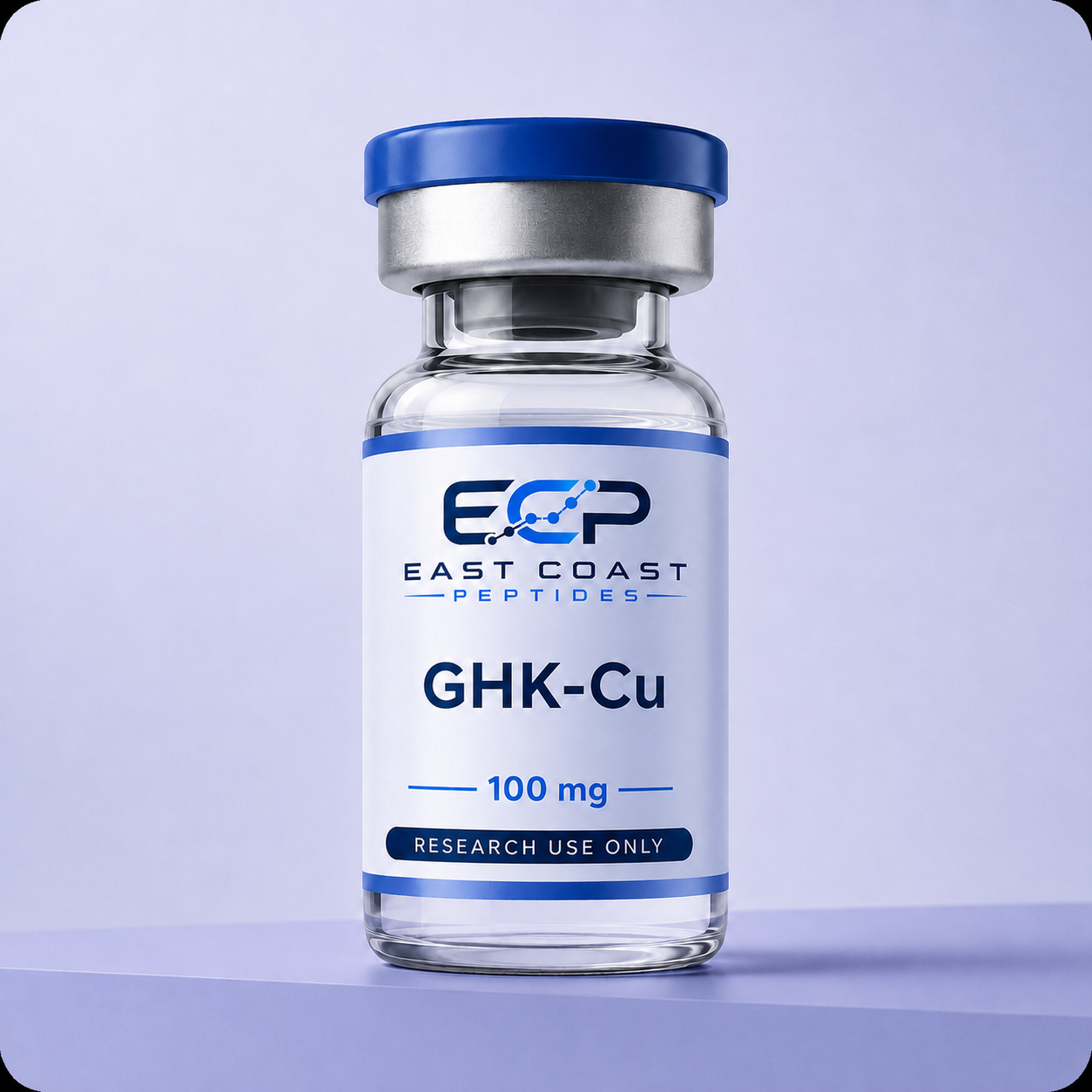
GHK-Cu Copper Peptide: What Laboratory Studies Show
Discover GHK-Cu's potential in healing, collagen production, and hair-follicle biology for enhanced skin health and repair.
In this article4 sections
Share on X (Opens in new window) X
Share on Facebook (Opens in new window) Facebook
Research focus What have laboratory studies reported?
A closer look at GHK-Cu research in fibroblast cultures and animal models, with links to the original studies and a clear explanation of their limits.
What is GHK-Cu?
GHK-Cu is a complex of the tripeptide glycyl-L-histidyl-L-lysine (GHK) and copper. Researchers have examined it in cell cultures and animal models to study extracellular-matrix components such as collagen and glycosaminoglycans. Results from those models describe the conditions of each experiment; they do not establish an effect in people or for a particular commercial research material.
What have laboratory studies reported?
In a 1988 fibroblast-culture study, researchers reported increased collagen synthesis after exposure to GHK-Cu. A separate 1992 study examined sulfated glycosaminoglycan synthesis in fibroblast cultures. These findings concern cultured cells, not a demonstrated outcome in humans.
A 1993 rat wound-chamber study reported greater accumulation of several extracellular-matrix components under its experimental conditions. Animal results cannot be assumed to apply to another model, formulation, or route of exposure. Research findings also differ: a later irradiated-rat-flap study found no difference from controls in its measured ischemia, vessel, or VEGF outcomes.
How should these findings be interpreted?
“GHK-Cu research” covers different materials, methods, controls, and endpoints. A change in a laboratory measurement does not by itself demonstrate a clinical benefit. Researchers evaluating a material should record its identity and lot, consult the applicable analytical report, and assess each publication in the context of its own study design.
ECP’s GHK-Cu product page provides product details. The COA Catalog provides available lot-specific documentation. A report describes the lot it identifies; it does not verify that the product will reproduce the results of a published experiment.
Research use only. ECP products are supplied for laboratory research, not for human or veterinary use. This article is educational and makes no medical, therapeutic, or dosing recommendation.
Original studies
Iamin et al., 2013 — irradiated rat model not constitute medical, cosmetic-treatment, therapeutic, or dosing advice.
Maquart et al., 1988 — collagen synthesis in fibroblast cultures
Explore compounds with clarity.
Review the ECP catalog alongside clear product information and available quality documentation.
Leave a Reply